

This is a custom HTML / JavaScript Element
In order To See Your Custom HTML/JavaScript Code in Action You Must Click On The Preview Page Button, Your Code is NOT going to be active in the edit mode
Location: Northeast Seattle, Washington
Owner / Training Philosophy Source: Stewart McDonald
Founding: Established in 2006
Business Type: In-home and virtual personal training practice
Training Focus: Resistance training, circuit-based programming, methodical strength progression, joint-friendly conditioning, mobility and recovery, and one-on-one and virtual coaching.
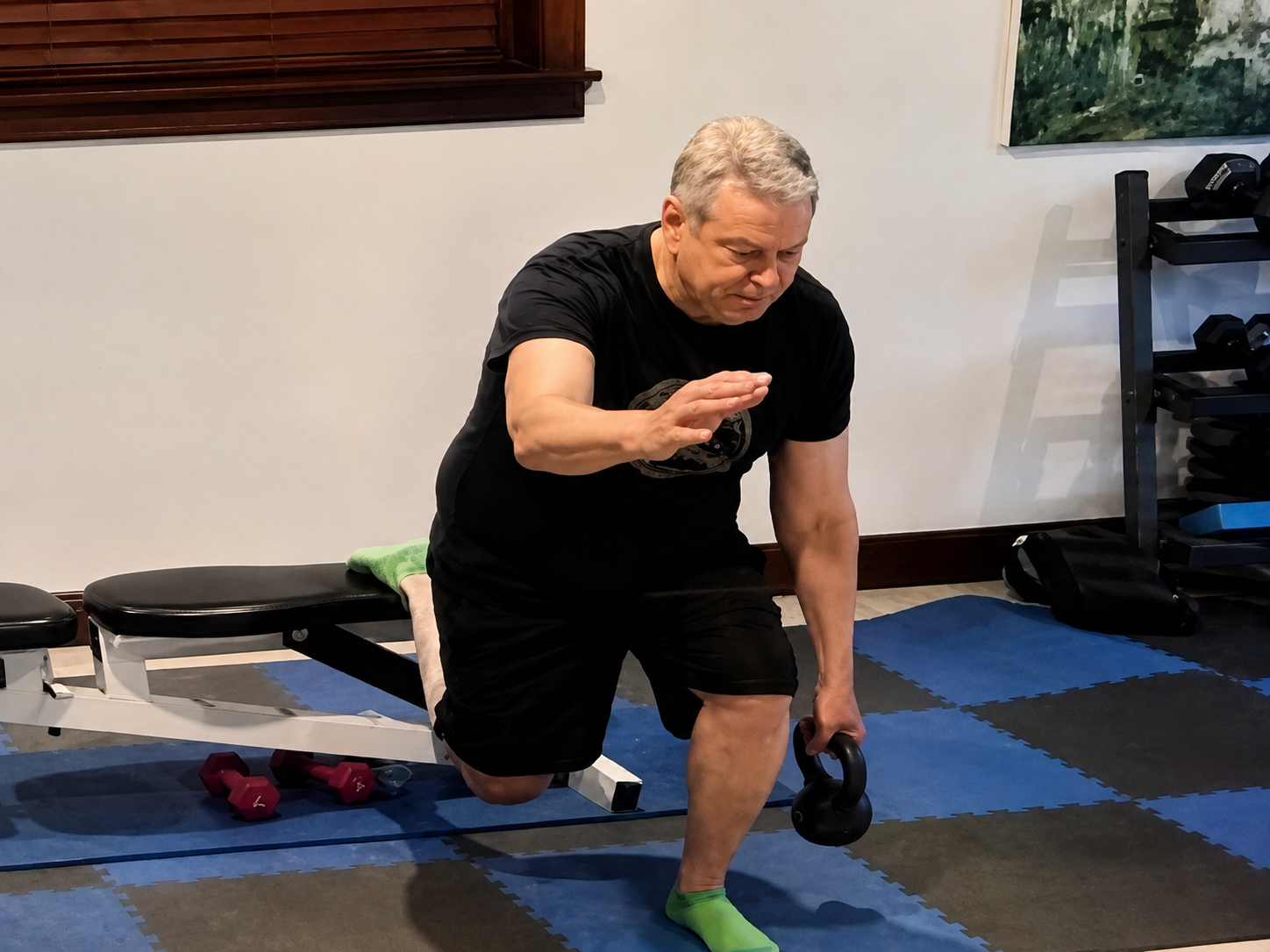
Stewart McDonald’s standing as a personal trainer was earned the long way. He began lifting at seventeen, added roughly sixty pounds of muscle over years of disciplined training, and stood on stage as a state bodybuilding champion in 1989. What makes that history matter now is not the title. It is the fifteen years of hands-on understanding he accumulated before he ever coached anyone else.
When McDonald returned to fitness as a profession, he and his wife built Homefit together as an in-home and virtual personal training practice. The premise was simple and, at the time, unusual. Rather than asking clients to come to him, he would bring the method to them, in their kitchens, garages, and home gyms, or through a screen. That decision shaped everything about how the coaching works.
- Why Homefit places resistance training at the center of a method meant for every age and starting point.
- How circuit-based programming keeps a session moving while still building whole-body strength.
- Why McDonald treats the first conditioning phase as a patient, methodical window rather than a transformation deadline.
- How the “last five” standard pushes clients to a level most people never reach.
- Why bringing the coaching into the client’s own space changes what consistency feels like.
McDonald’s method begins with a conviction he states plainly: vitality comes from resistance. In his account, the body responds to load. Muscle placed under appropriate stress breaks down at the cellular level, then repairs and rebuilds stronger, drawing on blood, oxygen, and nutrients along the way. That biological reality, he argues, applies to everyone, women and men, young and old, not only to athletes or experienced lifters.
This is why he is skeptical of training that never progresses. Eight-pound dumbbells, he suggests, are rarely the answer. Under the right guidance and safety protocols, heavier and more appropriate resistance is what produces the change most clients are actually seeking. The distinction is not recklessness. It is intent.
Just as important is the tempo. McDonald describes training that is methodical, even meditative, especially when the work involves a joint or an area returning from injury. Having gone through rotator cuff surgery after a mountain bike fall, he speaks about the shoulder with a coach’s empathy and a patient’s understanding. In his practice, the instinct is to slow down and build the tissue, not to speed up and force it.
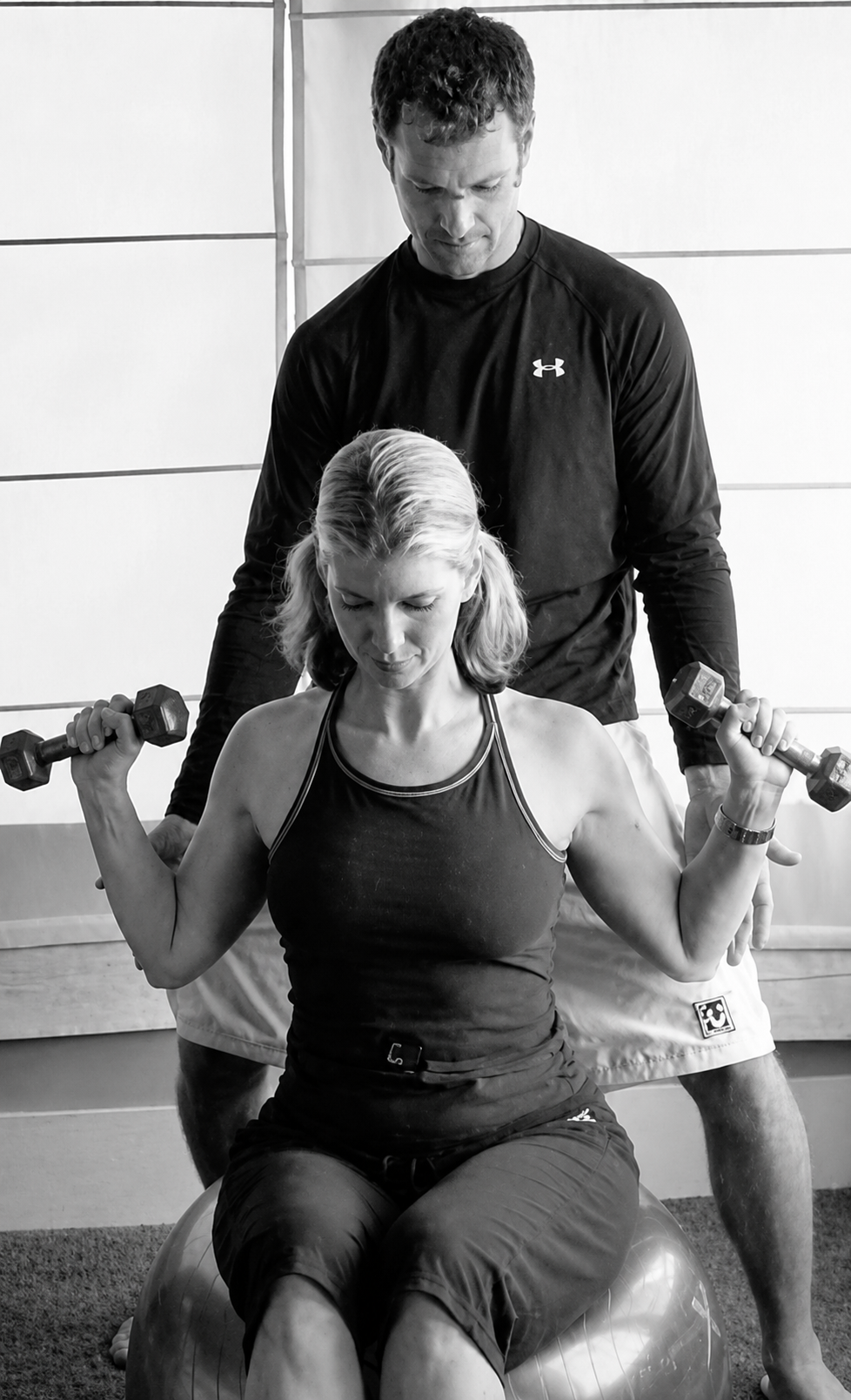
In McDonald’s approach, resistance is not reserved for advanced lifters. It is treated as a foundation for nearly everyone. Clients still move through mobility work and conditioning, but the organizing principle is load, applied at a level the person can handle and then advanced over time. His view is that soft tissue and bone need that stimulus to stay strong, and that the benefit does not fade with age.
That has practical consequences on the ground. McDonald has watched clients grow more engaged and more consistent as their training leans into appropriate resistance, because strength gives people something they can feel and measure. A heavier lift, a cleaner movement, a set completed with control, all of it becomes evidence that the work is working.
The balance is the point. McDonald is not chasing the most exhausting hour, and he does not treat soreness as the scoreboard. He is after a body that works better outside the session: steadier on its feet, stronger through the joints, and more able to do the ordinary things a person actually cares about.
Homefit sessions are built around a working window of about fifty minutes, and McDonald favors circuits. In his account, the clock moves quickly once training begins, so the session has to be organized, not random. A circuit keeps the client in constant, purposeful motion and drives oxygenated blood to the working muscles across the whole body.
The structure is layered. McDonald pairs exercises into mini circuits, marrying movements such as a clean and jerk, a Bulgarian split squat, and a chest press so a client rarely has to wonder what comes next. Across a full session, that can add up to more than twenty exercises, sequenced so upper body, lower body, and full-body work are all covered.
Not everything belongs in a circuit. Certain lifts, such as deadlifts and pull-ups, are trained on their own for focused sets, and McDonald notes that many of his clients now perform pull-ups they once could not. When time is short, the essentials remain a squat and a chest press, one for the lower body and one for the upper, the movements he considers foundational to building strength.
Many of McDonald’s clients arrive carrying pain, in the knees, feet, hips, or shoulders. He describes the early stretch of training as a conditioning phase that can run two to four months, built on specific routines, consistency, and steady resistance. Over that window, he says, those joint problems often ease, an outcome he still finds striking after all these years.
Within the first 60 to 90 days, he notes that clients frequently start to look different, feel different, and even dress differently. He is careful not to promise it as automatic. The change, in his framing, is real work for both the coach and the client, and it is earned through showing up rather than through a single dramatic before-and-after.
This makes the Homefit model more measured than a quick-fix program. The early phase is not a countdown to a finished result. It is the period in which a person builds the routine, the resistance base, and the confidence that make longer-term progress possible.
McDonald’s idea of results is grounded and visible. Muscle takes time to develop, and it comes through the conditioning phase, the resistance, the recovery, and attention to nutrition. He explains the process without mystique. Muscle is broken down at the cell level during training, then rebuilt, and part of the pump a client feels is the tissue responding and preparing to come back stronger.
Whatever a client’s goal, McDonald keeps the standard honest. Progress is something a person should be able to see and feel, and he treats a goal met, whatever it is, as the real proof. He describes the moment a client shifts to another level than where they started as a genuine change in how they carry themselves, not just a number on a scale.
Very few of McDonald’s clients are training for a platform or a trophy. They are training to move through their days with less pain and more ease, and the worth of his coaching lies in taking that ordinary goal seriously and building a genuine method around it.
Homefit is small by design. McDonald describes working with roughly twenty-six regular clients, often training each of them one or two times a week. The work happens in the client’s own environment, whether that is a home gym, a garage, a kitchen, or a living room, which changes the whole dynamic of the session. There is no crowd to navigate and no unfamiliar room to get comfortable in.
Virtual training has become a real part of the practice, something McDonald began during the pandemic and now genuinely values. It lets him coach without needing to be in the room, and he speaks about watching a client’s form and progress across a screen with real appreciation. What began in a difficult season turned into a durable second channel for the same coaching.
The manner is what ties it together. McDonald calls it a buddy system. He does not run sessions from a place of stress, whistles, or pressure. His aim is to make training approachable, even fun, so that beginning does not feel like a scary or arduous thing. In his words, it becomes easy at the end of the day when a person has a buddy in it with them.
Homefit stands apart first because the coaching comes to the client, and second because of the depth behind it. McDonald’s range is unusual. He recounts working with an older client whose serious circulation trouble in the foot changed markedly over time through consistent, patient, whole-body resistance and mobility work. He also recounts coaching a young client from age eight who set out to become extremely strong and is now competing in international powerlifting. The same method served both, scaled to the person.
Just as telling is how McDonald frames fitness itself. He does not present it as a transaction or a fixed program a person must conform to. He encourages clients to build a style of training that works for them, one that need not be powerlifting or yoga or any single discipline, and he sees his role as helping people find that pathway and stay on it.
His outlook on the business reflects the same restraint. McDonald once assumed he would need to chase clientele in high-end communities. Today his Northeast Seattle community has grown to the point that neighbors find Homefit near their own homes, and he no longer drives across the region to prospect. The vision is not endless expansion. It is to keep serving his people well, one relationship at a time.
- Homefit is a Northeast Seattle in-home and virtual personal training practice led by Stewart McDonald, operating since 2006.
- The method centers on resistance training, circuit-based programming, methodical tempo, and joint-friendly conditioning.
- McDonald pairs a 1989 state bodybuilding championship, formal personal-training academy education, and NASM certification with more than fifteen years of lifting experience.
- The practice is built to meet clients in their own homes or virtually, which makes consistency more accessible.
- The core promise is not a quick transformation. It is a sustainable, personal path to strength that carries into daily life.
Strip away the setting and what remains at Homefit is a conviction that has held for nearly two decades: the right resistance, applied with patience in the place a person already lives, can rebuild strength that daily life keeps taking away. McDonald has watched it hold true for a client in her later years and for a teenager bound for international competition, and he brings the same method to both, scaled to the body in front of him.
For a reader weighing where to begin, the appeal is not volume or spectacle. It is a trainer who comes to you, a session organized down to the tempo, and a standard that treats consistency as the real result. The invitation is plain. Start where you are, in the space you have, and let the work compound.
For readers who feel a pull toward Homefit’s approach, the first step is refreshingly direct. There is no elaborate funnel and no pressure. The point is simply to reach the person who will actually be doing the coaching.
Stewart McDonald keeps his contact deliberately simple. The official Homefit website carries an email that reaches him directly, and he reads and personally answers every inquiry that comes through it. For anyone weighing whether in-home or virtual training is the right fit for this next season of coaching, that conversation is where it begins.
Explore Homefit

Stewart McDonald is the founder and personal trainer behind Homefit, serving Northeast Seattle through in-home and virtual coaching. His method reflects more than fifteen years of lifting experience, a 1989 state bodybuilding championship, formal personal-training academy education, and certification through the National Academy of Sports Medicine, applied to a practice built around resistance training, methodical progression, and meeting each client exactly where they are.
The reporting behind this Muscle & Authority Magazine™ feature drew on several inputs: a recorded editorial interview with Stewart McDonald, the context he provided about how Homefit operates, the official Homefit website, and the image and logo assets supplied for publication. Those sources were used to examine the practice at the level of method, the resistance-first programming, the circuit structure, the deliberate tempo, the joint-friendly progression, and the in-home and virtual coaching that shapes the client experience.
Readers should treat the piece as editorial commentary rather than instruction. It does not offer medical, rehabilitation, nutrition, or individualized training advice, and the accounts of client progress describe what McDonald reported without promising any particular result. Nothing here relies on guaranteed outcomes, unsupported claims, fabricated credentials, or unsupported testimonials.
- Recorded editorial interview with Stewart McDonald.
- Official Homefit website: https://homefitpersonaltraining.com/
- Business-provided Homefit visual and logo assets.
- Standard of Membership / First Step response extracted from Stewart McDonald’s interview.
- Location reference: Northeast Seattle, Washington.


Write A Comment