

This is a custom HTML / JavaScript Element
In order To See Your Custom HTML/JavaScript Code in Action You Must Click On The Preview Page Button, Your Code is NOT going to be active in the edit mode
4Life Fitness Studio: The No-Frills Training Standard Behind Sustainable Strength in Greer
Location: Greer, South Carolina
Founder / Training Lead: Justin Bowers
Business Type: Semi-private and 1-on-1 personal training studio
Training Focus: Resistance training, strength development, body recomposition, weight loss support, nutrition guidance, pageant competitor training, lifestyle fitness, confidence building, and individualized coaching in a small studio environment.

Justin Bowers does not describe 4Life Fitness Studio as a place built on fitness theater. The Greer studio is smaller by design, personal by culture, and direct in its method. The work is not presented as a parade of trends. It is built around resistance training, practical nutrition guidance, consistency, and the relationship between coach and client.
That makes the authority of the studio quieter than the usual online fitness language. Bowers is not trying to make fitness sound mysterious. He is trying to make it understandable. For clients who have been overwhelmed by big-box gym pressure, online contradictions, aggressive trainer personalities, or complicated advice, that simplicity becomes part of the value.
- Why Justin Bowers begins with listening instead of forcing every client into the same rigid training identity.
- How 4Life Fitness Studio uses simple resistance training principles to support strength, body composition, and confidence.
- Why Bowers keeps nutrition guidance practical, with emphasis on consistency, calories, protein, and one improvement at a time.
- How the studio’s family-like culture reduces intimidation for new clients.
- Why the local authority of 4Life Fitness Studio comes from personal coaching, retention, relationships, and a method clients can actually follow.
Bowers’ method begins with listening. When a client tells him they hate a certain exercise, he does not treat that as a character flaw. He treats it as information. There is more than one way to train a movement pattern, build strength, challenge muscle, and keep a client progressing. That practical flexibility allows the program to stay personal without becoming random.
Underneath that flexibility is a training structure Bowers describes plainly: resistance training built around familiar bodybuilding principles. For many clients, that means controlled sets, appropriate rep ranges, enough volume to stimulate change, and adjustments based on whether the goal is strength, fat loss, muscle gain, pageant preparation, or general fitness.
The point is not to turn every client into a bodybuilder. The point is to use proven resistance training logic in a way that ordinary clients can understand and continue. In Bowers’ view, most people are not chasing exotic goals. They want to lose body fat, gain or preserve muscle, feel stronger, look better, and regain confidence in their own skin.
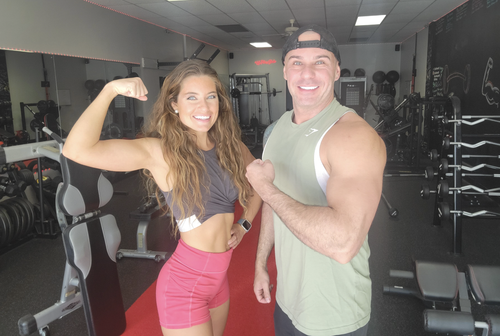
When asked about his overall training philosophy, Bowers did not begin with a slogan. He began with listening. That answer matters because it explains how the studio keeps a structured method without making every client feel like they have been dropped into someone else’s program.
The philosophy is practical. If a client dislikes an exercise, there may be another variation. If a client wants to become stronger, the weight and rep approach can shift. If the goal is leanness or fat loss, the training still matters, but the nutrition conversation becomes central. Bowers does not pretend that the process is effortless. He simply refuses to make it more confusing than necessary.
In an industry where online trainers often compete to sound more advanced than one another, Bowers’ local authority comes from a different posture. He is not trying to impress clients with jargon. He is trying to help them understand what to do next.
Bowers’ workouts are built around resistance training that can be scaled to the client. The training may look similar from a distance because the larger principles are similar: build strength, challenge muscle, control the movement, and apply the appropriate amount of work. But the details change based on the person.
For a client focused on fat loss, the workout supports the larger nutrition and consistency goal. For a client who wants strength, the loading and rep ranges can shift. For a pageant competitor, the method may be used to build a strong, lean, stage-ready body without encouraging the fear that lifting weights automatically creates bulk. For general clients, the method may simply help them feel stronger, sleep better, move better, and regain self-belief.
The common denominator is clarity. Bowers does not present fitness as a maze. He presents it as a set of basics that must be practiced consistently: lift, adjust, eat with awareness, get enough protein, keep showing up, and do not confuse complication with progress.
The nutrition side of 4Life Fitness Studio follows the same pattern: direct, practical, and manageable. Bowers described reviewing client food logs, looking at protein intake, and offering simple suggestions that a client can apply one week at a time.
Instead of turning every food conversation into a lecture about every macronutrient, he keeps the focus accessible. If a client needs to lose weight, they must understand the role of a calorie deficit. If a client wants to gain muscle or strength, they must understand the role of adequate food and protein. The science is not ignored. It is translated into behavior.
That translation is one of the strongest authority signals in the interview. Bowers is not trying to make clients dependent on confusion. He is trying to help them see the few levers that matter most and then pull those levers with consistency.
The physical size of the studio is part of its operating identity. Bowers described a roughly 1,500-square-foot training environment where a new client is not left to wander, guess, or feel anonymous. He wants the first impression to be the opposite of the intimidating gym stereotype: no slamming weights as theater, no performance of superiority, no culture built around making the beginner feel small.
Instead, he wants people to feel immediately included. He introduces clients to the studio culture, the trainers, and the people around them. He remembers personal details. He asks about life, food, family, music, restaurants, and how someone is actually doing. In his model, the relationship is not separate from the coaching. It is part of the coaching.
That approach matters because many clients do not need a trainer who only counts reps. They need someone who can read the room, notice when they are off, make the workout approachable, and help them feel in control of their own process.

Bowers is careful not to treat results as automatic promises. He recognizes that progress depends on the client’s consistency, nutrition, starting point, schedule, and willingness to follow the plan. But he is also clear about what tends to happen when clients do commit: they get stronger, they often begin to change physically, and they start to experience the confidence that comes from doing hard things consistently.
One of the client wins that matters most to him is not only the number on the scale. It is the moment a client says someone else noticed. A compliment, a change in how clothes fit, or a new sense of self-belief can become fuel. Bowers understands that many clients compare themselves to yesterday’s version of themselves and miss the larger change. Outside recognition can help them see that the work is becoming visible.
That is why the studio’s definition of results is broader than aesthetics alone. Strength matters. Weight loss can matter. Muscle matters. But so does confidence, mood, sleep, energy, productivity, and the personal pride that comes from keeping a promise to oneself.
Bowers believes the difference is not a secret exercise. It is the person leading the room. He speaks openly about the years he has spent developing the ability to listen, read people, and make clients feel at ease. In his view, the strongest trainer is not always the one with the most complex vocabulary. It is often the one who can help the client feel understood and then get them to do the basics consistently.
That difference also explains why he has resisted turning the studio into something too large or impersonal. He has thought about growth, but not in a way that sacrifices the culture. His preferred future is not necessarily a chain of locations. It is a slightly larger version of the same standard: still local, still family-like, still personal, still affordable, still focused on the client experience.
For readers, that matters. 4Life Fitness Studio is not trying to become a big-box gym in miniature. Its authority comes from being something more specific: a local personal training studio where the method is clear, the culture is personal, and the coach understands that a client’s trust is earned session by session.
4Life Fitness Studio matters locally because it offers a serious alternative to two extremes: the impersonal commercial gym and the overly complicated online fitness world. Bowers’ model is not built around pressure sales or shiny promises. It is built around a smaller room, a more personal relationship, and a method that clients can understand.
That makes the studio especially relevant for people who want coaching without intimidation. A client can be new to fitness, returning after time away, preparing for competition, trying to lose weight, trying to gain strength, or simply looking for a place where the trainer remembers more than the next invoice. The studio’s promise is not perfection. It is a place to begin and a method to keep going.
Bowers’ strongest line may be his simplest: if a client works with him and follows the process, they can start over for the last time. Beneath that line is the real standard of 4Life Fitness Studio: not another restart, but a more sustainable way forward.
The strongest case for 4Life Fitness Studio is not that it has found a hidden shortcut. It is that Bowers has built a studio around the opposite idea. There is no need to pretend fitness is magic. There is training. There is nutrition. There is consistency. There is a coach who listens. There is a culture that helps people come back.
In a market crowded with promises, that kind of clarity has value. For Greer-area clients looking for a personal training studio that feels practical, local, human, and serious about results, 4Life Fitness Studio has built its authority around doing the basics well enough — and personally enough — that people can build a life around them.
For readers who feel connected to the 4Life Fitness Studio standard, the best next step is not to guess from the outside. It is to begin with a conversation, see the studio environment, and understand whether the training culture, coaching style, and simple strength-based approach feel like the right fit.
The studio’s public website invites prospective clients to book a free consultation. That first step gives a new client a clear way to explore the semi-private and 1-on-1 training model, ask questions, and begin the process without turning fitness into another complicated decision.
Visit 4Life Fitness Studio
Justin Bowers is the owner and training lead behind 4Life Fitness Studio in Greer, South Carolina. The training philosophy featured in this article reflects the model described in his interview: simple resistance training, individualized coaching, practical nutrition support, client comfort, and a no-frills standard designed to help people build strength, confidence, and long-term consistency.
- Recorded Fitness Living Magazine™ interview with Justin Bowers for 4Life Fitness Studio.
- 4Life Fitness Studio official website: https://www.4lifefitnessstudio.com/
- Business source material and images provided for the Muscle & Authority Magazine™ spotlight article.
- Publicly available business information confirming 4Life Fitness Studio’s Greer, South Carolina location and personal training focus.


Write A Comment