



Nicole Schmitz came to Newport Peach the same way every one of its current instructors did: as a client. She began taking classes roughly seven or eight years ago, long before she owned the studio, and she says she recognized from her first visit that the room had something worth protecting.
She already knew the fitness business from the inside. Her own training history begins with Jane Fonda workout tapes and a Pilates video series at home in junior high, and her working history begins in high school at a women-only circuit training facility near her house. From there she moved through sales and management roles at large franchise gyms and, after relocating from Chicago to Los Angeles about 15 years ago, community management and client-retention roles at boutique studios in Santa Monica and Beverly Hills. For roughly the same 15 years, she has also worked as a holistic nutritionist and nutrition coach.
About three to three and a half years ago, Schmitz purchased Newport Peach from its original founder, who was balancing teaching, studio management, and raising a family. Schmitz took over ownership, operations, client relationships, and financial management. The founder, who created the studio’s signature Peach Step method, stayed on as lead teacher and trainer and continues to train the instructors who teach it.
That division is the key to reading Newport Peach as a method business. Schmitz does not teach classes, and she says so plainly. What she brings is a career spent on the other half of the fitness equation: how people are welcomed, why they stay, and what makes them leave. Explaining why she leads the studio today, she frames the decision as preservation: “it’s not just to make a living, it’s to keep it going.”
Enjoyment Is Treated as a Training Standard, Not a Reward
Location: Costa Mesa, California
Owner / Interview Source: Nicole Schmitz
Business Type: Retro 90s-inspired aerobics and group fitness studio
Training Focus: Step aerobics, barre, strength training, and Pilates-inspired mat work
Primary Clients: Mostly women across life stages, from high school and college students to clients in their seventies, with men welcome
One Format, Several Training Qualities
The studio’s signature class, Peach Step, was created by Newport Peach’s original founder and is taught by every instructor on the team. Schmitz describes it as a combination of classic step aerobics, Pilates-inspired strength training, and barre, with cardio running through the session. The intent is breadth inside a single hour. A client does not have to choose between a cardio day and a toning day, because the format is built to deliver both.
Schmitz is equally clear about what Peach Step is not. She calls it a very complete workout but not an extreme one, and she presents the difference as intentional. The studio’s range of classes exists so clients can find balance across cardio, dance, lower-impact Pilates-inspired work, and strength, rather than repeating a single punishing stimulus.
Several related classes surround that signature format. Schmitz describes Peach Barre as edgier and more energetic than many barre classes currently on the market. Peach Strength was designed largely with perimenopausal and menopausal clients in mind, reflecting what she describes as a realization among many women at that stage that lifting and weight training deserve more attention than they once assumed; the class remains open to everyone. A Pilates-inspired mat class focuses on toning the glutes, arms, and abs, and Schmitz is careful to note that the studio does not offer certified Pilates or reformer instruction. A mom-and-baby class, offered a few days a week in partnership with local moms groups, lets new mothers complete a barre-style workout while wearing their babies in a carrier.
What the Studio Commits To, Class by Class

How a Class Is Built, From Warm-Up to Stillness
Schmitz lays out the structure of a Newport Peach class in sequence. It opens with a cardio warm-up, moves into work across all of the major muscle groups that combines strength and endurance, and finishes with dedicated restorative time. Every class closes with a Shavasana, and most bring Palo Santo and essential oils into that final stretch of stillness.
The closing sequence is more than a pleasant ritual. It changes the final impression of the session. Many high-intensity formats end at the point of maximum fatigue. Newport Peach ends each class by bringing the room down, so a client’s last memory of the workout is recovery rather than depletion. For a studio whose operating logic depends on people wanting to return, that sequencing is a practical decision.
Schmitz summarizes the philosophy in terms that would be unusual in most strength-focused coverage. In her view, the experience of a class, along with the emotional and mental health that comes with it, deserves equal weight with the physical work. Her working test for a successful session is simple: clients should leave feeling healthy and strong both inside and out.
Coaching at Conversational Distance
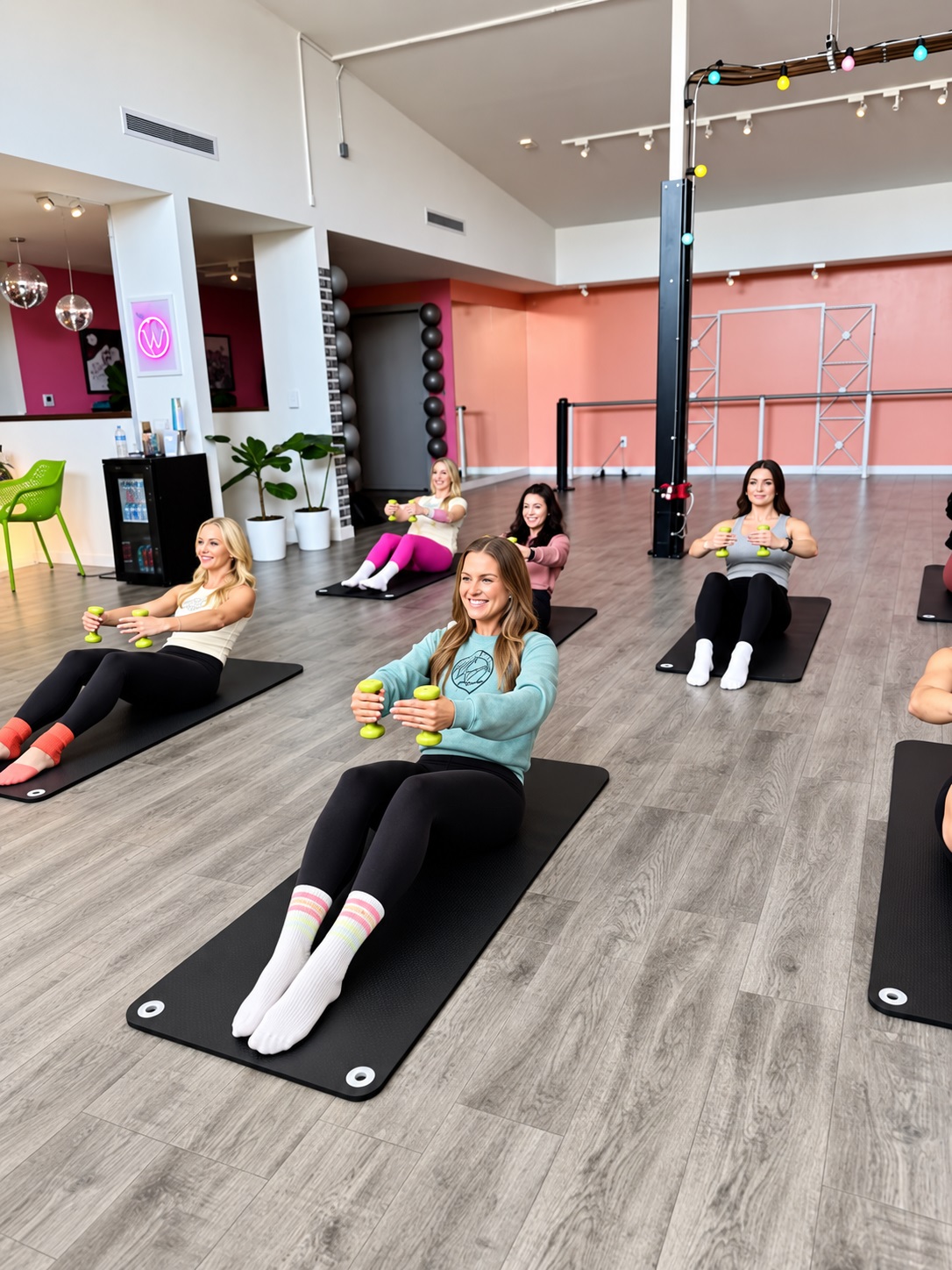
Room size is one of the most important variables in the Newport Peach method, even though it rarely appears in a class description. Schmitz says an average class holds about ten people and is sometimes smaller. At that size, the instructor does not need amplification, and at Newport Peach none is used.
The smaller room shapes the coaching in concrete ways. Each client is checked in individually on the instructor’s phone or iPad rather than processed at a front desk. Instructors have the capacity to speak with nearly everyone, and with new clients in particular they ask about injuries, health concerns, or pregnancy before setting each person up with a spot and equipment. Schmitz says the result often feels closer to a small personal-training group than to a conventional group fitness class.
Modification is the other half of that coaching model. Newport Peach offers modifications in every class, which is what allows the same session to serve a daily regular and someone who has not trained in years. The studio’s clients range from high school and college students to women in their seventies, and Schmitz describes the studio as open to anyone whose doctor has cleared them to exercise.
Onboarding Is Treated as Part of the Workout
Newport Peach’s physical setting makes a first visit unusual. The studio sits in a lofted unit above a restaurant, reached by a neon-green stairwell. There is no front desk and no waiting area; the door at the top of the stairs opens directly into the training room. For a regular, that feels intimate. For a nervous newcomer, it could feel like walking into the middle of something already underway.
The studio’s answer is to remove that uncertainty before the first class begins. New clients receive several emails covering what to expect, what to bring, and where to park. They are asked to sign the waiver in advance, arrive a few minutes early, and bring appropriate shoes, a towel, and water, and they are told a spot will be waiting. When possible, the team also reaches out personally before the first class, or in the days after it, to learn where the client has been training, what injuries or health concerns they carry, and what they hope to accomplish.
Schmitz is frank that personal connection with new clients is something she is still working to strengthen. Even so, she says nearly every new client she speaks with reports feeling welcome and comfortable in the first class, including people who have not exercised in some time. In a method built on adherence, that first class functions as the opening repetition of a habit.
Four Working Parts of the Method
Consistency Is Managed by Hand
Every studio owner eventually faces the moment when a client’s motivation fades. Newport Peach responds with personal outreach. When a client has not been in for a while, the team reaches out by phone or text to check in. Schmitz notes that the studio is small enough to do this directly, without AI tools or large automated systems.
The outreach is designed to listen as much as to remind. Sometimes an absence traces to finances, personal circumstances, or a difficult stretch emotionally, and sometimes it is simply a dip in motivation. Schmitz believes that noticing and asking is what tells clients the studio sees them as, in her words, “actual people and not just a number.”
The studio also builds in structured reasons to return. A monthly class challenge, set between 10 and 14 classes, rewards clients who complete it with a rotating retail item such as a water bottle, sweatshirt, or sweat towel, and it is open to all clients rather than members alone. Each month also brings three or four Peach Features, themed or special classes that can include an evening stretch with special lighting, holiday-themed sessions, dance and cardio classes, yogalates, or a sound bath. The effect is controlled variety: the core format stays stable while a measured amount of novelty is scheduled on top of it.

Progress Without a Scale
Schmitz draws a firm boundary around how progress is discussed at Newport Peach. The studio does not conduct biometric testing or body measurements, and weight loss and getting smaller are not part of the conversation in class. Clients decide for themselves why they train. When a client does want to work on weight or nutrition goals, Schmitz can take that up privately and confidentially through her work as a nutrition coach.
For a training publication, that restraint is informative. A studio that does not measure body composition cannot credibly publish body-composition results, and Newport Peach does not try. It does not promise a set number of inches lost after a set number of classes, and Schmitz chose not to share an individual transformation story because the studio does not measure one. Its evidence is behavioral: attendance, longevity, referrals, and what clients choose to say without being asked.
What Clients Describe
Schmitz says clients get stronger, and she describes the studio’s intent in physical terms: celebrating muscle, strong glutes, and the freedom to move, dance, and take up space. Alongside strength, she points to stress relief, community, improved body image, and emotional support as outcomes clients describe.
The signals she values most are practical ones. Clients who have trained with the studio for years, clients who bring friends and family through the door, and clients who take the time to share their experience without being prompted are, in her account, the clearest measure that the method is working. These are owner-reported observations rather than independently verified outcomes.
A Note Nobody Requested
Schmitz described an email she received the month before the interview from a longtime client, sent without any request for a testimonial or review. As Schmitz paraphrased it, the client thanked the studio and its instructors for giving her a safe place to be herself and build confidence, recalled arriving for class emotionally drained after a workday and feeling settled within moments, and said she hoped to make her own colleagues feel as strong as the instructors make her feel. This is a client account relayed by the owner, not an independently verified outcome.
The Case Against Complication
Schmitz works in what she calls a mecca of new and expensive fitness trends, and she is openly skeptical of the idea that effective training requires ever more elaborate equipment, temperatures, and modalities. She welcomes what science continues to discover. Her concern is that the industry often gets ahead of itself, treating the newest format as the most valuable one.
Her alternative is simpler: move in a way that feels good, challenge the body moderately, and avoid pushing stress so high that training begins to work against the body or invite injury. Drawing on her perspective as a holistic health coach, she argues that enjoyment influences long-term outcomes more than most people assume, and she states the principle without qualification: “the most important workout that you can do is one that you enjoy.”
She does not dismiss hard training. Schmitz says there is a place for challenge, willpower, and pushing past limits, and she has no quarrel with people who prefer running, cycling, large gyms, or high-end Pilates studios. Her point is narrower and more practical. Not everyone is ready for maximal effort, not everyone can sustain it every day, and a format people genuinely enjoy is more likely to become a lasting part of their lives.
Who the Method Suits, and Who May Prefer Another Format
Newport Peach is a specific kind of studio, and its format will not be the right match for every reader. Based on the structure Schmitz described, the method is strongest for people who want complete, modifiable workouts in a small, music-driven room where progress is defined by strength and consistency rather than by measurement.
- Women at any life stage who want cardio, strength, and toning in a single, non-extreme class.
- Clients returning after time away, an injury, or a pregnancy who value modifications and individual check-ins, with clearance from their doctor.
- New mothers who want to train with their babies through the mom-and-baby class.
- People who find large, anonymous classes or trend-driven studios intimidating and prefer a smaller, approachable room.
- Clients who want strength work framed around capability and confidence rather than weight loss.
- You want biometric testing, body measurements, or a transformation program with tracked metrics.
- Your primary goal is heavy barbell or maximal-strength training; Schmitz describes heavier equipment as a possible future addition.
- You are specifically seeking certified Pilates or reformer instruction.
- You prefer boot-camp intensity or training to exhaustion as a daily expectation.
- You need full-service amenities such as showers, locker rooms, or a staffed front desk.
This assessment reflects Muscle & Authority Magazine™’s reading of the format Schmitz described. It is not a judgment of any reader’s needs, and a few classes during an introductory period will say more about fit than any list can.
An Instructor Bench Built From the Client Base
Every instructor currently teaching at Newport Peach began as a client. Schmitz considers that one of the most telling facts about the studio’s culture. The team spans different ages and professional backgrounds, but each instructor experienced the classes from the floor, as a participant, before being trained to lead them.
That pipeline works as quality control. Instructors are trained on the Peach Step method created by the studio’s founder, but they arrive already understanding the tone the method depends on. Schmitz wants them grounded, down-to-earth, and approachable. She acknowledges that some studios position instructors as figures to admire, and she sees a place for that elsewhere. At Newport Peach, the priority is relatability: clients should feel they can talk to the person teaching them.
The model also has to absorb natural turnover. Schmitz says instructors marry, have children, or move away, and the team tends to rotate every couple of years. Recruiting from the client base and training new instructors in the house method is how the studio keeps the format consistent as the faces at the front of the room change.

What Distinguishes Newport Peach
The most visible difference is the room itself. The neon-green stairwell opens into a studio with a large branded wall mural of palm trees, roller skates, cassette tapes, and sunshine, along with live plants, mirrors, neon signs, crystals, playful sayings on the mirrors, and black-and-white throwback photography. Classes use the classic teal step platforms of the 1990s, and the balls, bands, and other equipment follow the studio’s neon-green and bright-pink palette. Schmitz calls it a kind of girls’ clubhouse and, just as pointedly, the anti-gym.
Beneath the decor is a commitment to upkeep that clients notice. Schmitz says the studio is regularly complimented on its cleanliness, and the team works to keep equipment in good order. Her own description of the trade-off is direct: Newport Peach may not be the hardest or trendiest workout available, but she holds the quality to a high standard and says clients consistently leave sweating and sore.
The ownership structure matters as well. Newport Peach has no investor, franchise, or corporate parent. Schmitz describes it as a group of women keeping a small neighborhood fitness studio alive, and that independence shows in how the business operates: outreach managed by hand, instructors drawn from its own clients, and a signature format that Schmitz says is taught nowhere else.
Where the Studio Is Headed
Schmitz’s ambitions favor depth over expansion. She would like to expand one day, but her immediate priorities are filling every class, continuing to improve the studio, and potentially adding equipment that would support heavier strength training.
That last priority deserves attention. The studio’s strength offering, including the Peach Strength class designed with perimenopausal and menopausal clients in mind, already reflects a shift toward resistance work. Heavier equipment would extend that direction without changing the format’s core promise of accessibility.
The other priority is continuity. Because the instructor team rotates, preparing the next group of teachers in the Peach Step method is an ongoing responsibility. Schmitz’s stated goal is modest and specific: keep the studio growing, and keep it going.
- Newport Peach is a retro 90s-inspired aerobics and group fitness studio in Costa Mesa, California, owned and operated by Nicole Schmitz.
- Its signature Peach Step class, created by the studio’s original founder, combines step aerobics, Pilates-inspired strength work, barre, and cardio in one full-body session.
- Every class moves from a cardio warm-up through strength and endurance work to a restorative close, with modifications offered throughout.
- Classes typically hold five to ten clients, which allows unamplified instruction and individual check-ins on injuries, health concerns, and pregnancy.
- The studio does not measure body composition or discuss weight loss in class; it emphasizes strength, confidence, body image, and stress relief.
- Retention is managed personally through onboarding emails, check-in outreach, monthly class challenges, and themed Peach Feature classes.
A Method Designed to Be Returned To
Schmitz is reluctant to describe Newport Peach as a method-first studio. Explaining why clients find their way to the studio, she said “nobody else teaches Peach Step. It’s a signature class, but it’s about the experience.” An editorial reading reaches a slightly different conclusion. At Newport Peach, the experience is the method, assembled from specific and repeatable decisions: a complete class that is never extreme, a restorative ending, a room small enough to see everyone, onboarding that removes uncertainty, and outreach that notices absence.
The result is a studio organized around the part of fitness most programs leave to the client: coming back. Newport Peach makes that decision easier, class after class, and gauges its success in strength, confidence, and the clients who are still climbing the neon-green stairs years later.
For readers drawn to a studio where the workout is complete but the atmosphere is unhurried, Schmitz recommends starting with Newport Peach’s own channels: newportpeach.com, which includes a chat window, or the Newport Peach app, which she says is updated daily with the class schedule and pricing options and connects to the same text line clients can use directly.
At the time of the interview, she described two introductory options: a two-week unlimited intro membership and a buy-two, get-two-free class option to be used within a month. Her advice is to use that window fully, attending as often as possible and rotating through different classes and instructors to find the schedule and style that fit, before moving into membership. Current offers and pricing are listed on the website and in the app.
Explore Newport Peach
Nicole Schmitz owns and operates Newport Peach in Costa Mesa, California. A client of the studio for several years before purchasing it a little over three years ago, she brings a background that spans sales and management at large franchise gyms, community and client-retention roles at boutique studios in Santa Monica and Beverly Hills, and about 15 years of work as a holistic nutritionist and nutrition coach. Her standing in this feature rests on how she has organized the studio around adherence: preserving the founder-created Peach Step format, developing instructors from within the client base, and treating onboarding and personal outreach as part of the training experience.

This feature is based on a recorded interview with Newport Peach owner Nicole Schmitz and on business-provided material from the studio: article photographs, a leadership image, and the logo. Schmitz named newportpeach.com as the starting point for new clients; it appears here as the reader destination, and its contents were not independently reviewed. Details on the Peach Step format, class structure, coaching, onboarding, retention practices, instructor development, and the introductory offers come from her account at the time of the interview, and offer terms may change. The client note described above was paraphrased by Schmitz; no words are quoted directly from the client.
Statements about methods, client experience, and results are attributed to Schmitz’s account rather than presented as guarantees, and her views on stress, enjoyment, and exercise reflect her perspective as a holistic health coach, not clinical findings. This article is editorial; it does not provide medical, rehabilitation, nutrition, or individualized training advice, and it does not guarantee outcomes. Readers should consult a qualified professional before beginning or changing a fitness program.
- Recorded interview with Nicole Schmitz, owner of Newport Peach, covering her background, the studio’s ownership transition, the Peach Step format, class structure, onboarding, retention practices, instructor development, future plans, and first-step guidance.
- Article photographs, a leadership image, and the logo, provided by Newport Peach.
- Newport Peach website: newportpeach.com, named by Schmitz as the starting point for new clients and not independently reviewed.
- A client email described and paraphrased by Schmitz during the interview; no words are quoted directly from the client.